


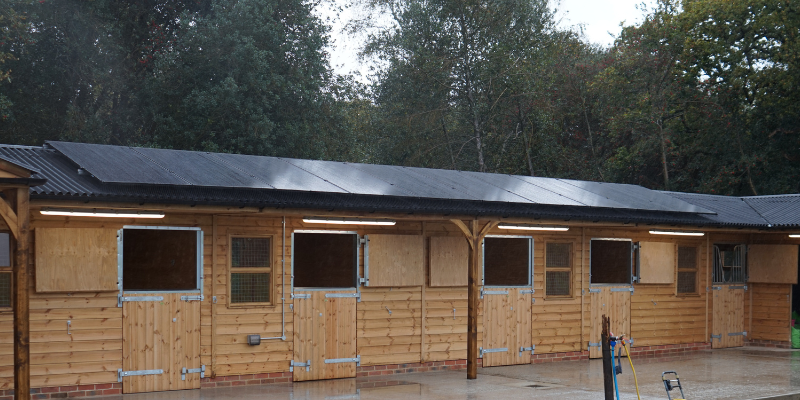
Yes, in most cases. Whether your outbuilding is a detached garage, a timber workshop, or a rural stable block, solar panel installation is usually achievable. What changes between jobs is the detail: the roof needs assessing properly, the cable route needs planning, and the right configuration depends on how you actually use the building. This guide covers roof suitability, planning permission rules, flat-roof and timber-structure specifics, grid connection, costs, and how to compare quotes properly.
This guide is for homeowners in Surrey, Hampshire and the wider South East. A good proportion of gardens here have outbuildings that are doing nothing for energy bills, so it is worth understanding what is involved before you start comparing quotes.
If you would rather talk through your specific situation first, get a free solar quote or use the online quote tool to start.
Three ways to set up solar on an outbuilding
Before you start comparing solar installation companies, it is worth being clear on which configuration you are actually after. They look similar from the outside but have different implications for system design, cost and what you get out of it day to day.
Panels on the outbuilding that power your home too
This is the most common setup when the outbuilding is close enough to connect to the main house supply. Panels go on the garage or workshop roof and the electricity feeds into your household supply in the normal way. It is a standard grid-connected solar panel installation, just on a different roof.
The main practical questions are: does your consumer unit have capacity for an additional connection, what is the best cable route between the buildings, and will any groundworks be needed for buried cables? Outbuilding installs often involve longer cable runs and additional isolation points compared to a house-roof job, which is worth understanding when you are reviewing quotes.
Our solar panel ROI guide breaks down payback and savings in detail. If you are on Octopus Energy, how Octopus tariffs work with solar is worth reading before you commission.
Solar mainly for the outbuilding itself
If the outbuilding already has its own supply and your goal is to offset what it costs to run, this is often the simpler route. It works well for daytime loads: lighting, tools, workshop equipment, anything you are running while you are actually there.
The catch is timing. Most garages and workshops get used in evenings or at weekends, when solar generates little or nothing. Battery storage can change that picture completely by holding daytime generation for when you need it, and it is much easier to design in from the start than to bolt on later.
If the supply needs upgrading to handle a solar connection, our domestic electrical team can assess that alongside the solar work.
Off-grid solar for buildings with no mains connection
For rural buildings where getting a mains connection is impractical or expensive, an off-grid system is worth serious consideration. Panels generate during the day, batteries store surplus, and an inverter converts stored energy into usable AC power when you need it.
Off-grid design requires more care than a grid-tied install. There is no mains supply to fall back on, so the system has to be sized for your actual loads rather than a best-case scenario, and you need clear shutdown procedures in place. Seasonal variation also matters more: shorter winter days mean less generation, and an honest system design will account for that rather than glossing over it.
Our battery storage page covers what is available, and EPS vs whole-home backup: what is the difference? explains backup power options clearly.
What counts as an outbuilding?
For solar purposes, an outbuilding covers most structures that are not your main house. Detached garages, carports, workshops, garden offices, garden rooms, annexes, stable blocks: all of these can have panels fitted. The type of structure does not change the overall approach, but it does affect some design detail, particularly around fixings, cable routing and fire safety.
One practical distinction worth knowing: planning rules treat panels mounted on a building differently from a ground-mounted array installed in the grounds. If your outbuilding roof turns out not to be suitable, ground-mounting is sometimes an alternative, though it has its own planning conditions.
The Planning Portal guidance on solar panels covers building-mounted panels. For ground-mounted arrays, the stand-alone solar equipment rules are the ones to check.
Is your outbuilding roof suitable for solar panels?
Outbuilding roofs vary far more than house roofs. They can be lighter, older and sometimes not properly looked at in years. A quick check before you get quotes can save time and set realistic expectations.
What you can check yourself
Walk around the building and look honestly at these four things:
- Condition: any leaks, rot at the edges, sagging between rafters, cracked or broken sheets, or patches repaired more than once? If so, sort the roof before adding panels. You do not want to be lifting an array off to fix underlying problems two years after installation.
- Roof type: pitched or flat, and what is the covering — felt, rubber, corrugated sheets, or something else? Different coverings suit different mounting systems, and we need to know before we can design the right setup for you.
- Shading: trees, hedges and neighbouring roofs are common in South East gardens. We factor shading into the system design as standard; an installer who ignores it will let the output disappoint you.
- Access: can an installation team safely reach the roof? Once panels are on, will you still be able to get to it for maintenance or future roof work? Worth raising at the survey stage, not after.
What a proper survey covers
A visual check is a starting point, not a sign-off. We verify that the roof can safely carry the structural load, including wind uplift — not just the static weight of the panels. For lighter outbuilding roofs, how loads transfer through the frame matters and needs to be properly checked.
The Planning Portal building regulations guidance for solar panels covers the regulatory requirements. The MCS MIS 3002 solar PV installation standard sets the quality bar for installation, and the LABC guide to retrofitting solar panels is a useful reference for structural and compliance considerations.
When you are at the stage of comparing panels, our guide to the best solar panel brands for UK homes gives an independent overview of what is worth specifying.
Can you put solar panels on a flat roof garage?
Yes, and it is one of the most common outbuilding solar projects across the South East. Flat-roof garages with felt or rubber coverings are well suited to solar, provided the mounting system is chosen and installed properly.
On a pitched roof, panels sit close to the surface and gravity keeps them there. On a flat roof, the mounting system has to create the tilt the panels need, manage wind uplift forces, and protect the waterproof membrane underneath. There are two main approaches: ballasted systems use weight to hold the frame in place without penetrating the membrane; mechanically fixed systems use fixings into the structure, which offers more resistance to wind loading but requires those fixings to be properly sealed.
Some lightweight garage roofs are not suited to all mounting systems. We assess your specific roof and specify accordingly rather than applying a default. Before you get quotes, it is worth knowing what to ask: how will the frame be fixed or ballasted, how is the membrane protected at any fixing points, and how will the roof be accessed for future maintenance once panels are in place?
The FMB guide to solar panels on a flat roof is a useful general reference. If your property is in a conservation area or on designated land, check the Planning Portal solar panel planning permission guidance before assuming you are fine.
Solar panels on a wooden or timber outbuilding
Timber-framed outbuildings can have solar panels on them, but they need more care than a brick-built garage. The reason is variability: a well-built garden office with a solid modern roof is a completely different proposition from an ageing wooden workshop with a thin felt covering, and we need to understand exactly what we are working with before committing to a price.
On any timber structure, cables need to be properly contained rather than surface-clipped and exposed. Isolation points should be in accessible, clearly labelled locations. Written shutdown guidance should be left with the property. And monitoring should be set up before handover, so you have a baseline for what normal operation looks like.
UK guidance on fire safety with solar emphasises good installation practice, proper cable routing and clear isolation as the key protections — not the structure type itself. The GOV.UK fire safety guidance for solar PV panels on roofs and the full fire safety solar PV report from February 2026 set out the official position. An MCS-certified installer should follow this as a matter of course.
The LABC retrofitting solar panels guide also covers structural considerations relevant to non-standard roofs.
What to do if the garage roof might contain asbestos
Get specialist advice before any work goes ahead. Do not drill it, cut it, pressure-wash it or disturb it in any way until you know what you are dealing with.
Corrugated asbestos cement was widely used on UK garages and outbuildings built before the mid-1980s. At a distance it can look similar to modern fibre cement or corrugated metal, but it requires completely different handling. The HSE asbestos essentials guidance explains what the rules are.
Fragile roofs are a related risk. Older corrugated sheet roofs can be structurally fragile in ways that are not obvious from the ground, which affects how safely anyone can work on them. The HSE guidance on working on fragile roofs sets out the relevant precautions.
If the roof is not safe to work on, the sensible options are: have it professionally removed and replaced before revisiting solar, use the main house roof instead, or explore a ground-mounted array where the site and planning rules allow. The alternatives section towards the end of this guide covers each of those.
Do you need planning permission for solar panels on an outbuilding?
Usually not. In England and Wales, most domestic solar panel installations fall under permitted development rights, which means no planning application is required. There are conditions attached to those rights, though, and there are situations where you should check before assuming you are clear.
Check if: your home is listed, the property is in a conservation area, national park or AONB, or you are not certain the standard conditions are met. This matters more in Surrey and Hampshire than in some other parts of England, because both counties include a significant amount of designated land. AONB coverage in particular is extensive across the Surrey Hills and much of rural Hampshire.
The Planning Portal permitted development guidance for solar panels covers the general rules. For the specific conditions that apply to panels on a detached garage or other curtilage building, see solar equipment on a curtilage building: limits and conditions.
Building regulations apply separately and cover both the structural check and the electrical installation. We confirm what applies to your project and handle the documentation. The Planning Portal building regulations guidance explains what is covered.
You can see the certifications and accreditations we hold, including our MCS and NICEIC certifications and our registrations with TrustMark and RECC, on our accreditations page.
Grid connection, network notifications and export payments
Most homeowners do not need to handle any network paperwork themselves. We do it. But it is worth understanding what is happening.
Two technical standards govern how small solar systems connect to the grid in the UK. G98 covers smaller or simpler systems through a notification process. G99 applies where prior approval from the local network operator is required, typically for larger or more complex setups. We confirm which route applies and manage it from start to finish. The G98 Single Premises Summary Guide and the G99 Type A Summary Guide from Energy Networks Association set out the technical detail for each.
On export payments: if your system sends surplus electricity back to the grid, you can earn money through the Smart Export Guarantee. Rates vary between suppliers, and eligibility conditions apply. The GOV.UK Smart Export Guarantee guidance covers the details; we can advise on the application once the system is commissioned.
The full process runs: survey and system design, then connection route confirmed, then solar panel installation, then commissioning and testing, then paperwork handed over, then export tariff application if applicable. If you are on Octopus Energy, how Octopus tariffs work with solar and how much can solar panels really save you? are worth reading before you commission.
What a good solar installation looks like at handover
A well-installed system is more than panels on a roof. It is a setup where you know how it works, you can shut it down safely, and everything is labelled and documented. This matters more on outbuildings, where the system is some distance from the house and might be accessed less often.
At handover, we walk you through where the isolators are and how to use them. That information is written down and left with the property — not just explained verbally and forgotten. All key components are labelled clearly. The monitoring is set up and demonstrated at handover, so you can see at a glance that the system is performing normally and would notice if something changed.
The GOV.UK fire safety guidance for solar PV panels on roofs is the authoritative reference on safe installation practice. If the outbuilding supply or isolation needs separate electrical work, our domestic electrical team can handle that alongside the solar installation.
What affects the cost of solar panel installation on an outbuilding?
Outbuilding solar installation costs tend to run a bit higher than a straightforward house-roof job. Knowing why helps you assess quotes properly rather than just comparing bottom-line figures.
The main factors are: whether scaffolding or specialist access equipment is needed; whether the roof needs reinforcing before mounting can go ahead; which flat-roof mounting system is appropriate; how long the cable runs are and whether groundworks or trenching is involved; what electrical upgrades are required at the consumer unit; and whether battery storage and monitoring are included in the scope.
When you are comparing quotes, check that each covers the same things: a proper survey and system design, evidence of roof suitability assessment, commissioning and a full handover pack, and network or export paperwork where applicable. A quote that omits any of those is not a fair comparison with one that includes them all.
The Energy Saving Trust’s guide to the solar installation process gives a good independent view of what a thorough process should look like. On VAT: as of early 2026, solar panel installations for domestic properties in Great Britain qualify for 0% VAT. This is subject to change; check the HMRC notice on VAT for energy-saving materials (Notice 708/6) for the current position.
Ready to find out what your project would cost? Get a free solar quote. Already have solar and thinking about adding battery storage? Find out about adding battery storage to an existing system.
What a real outbuilding solar installation looks like
It helps to see what this looks like on an actual job rather than a hypothetical.
The situation
A rural stable block with no mains electricity connection. Running a supply from the grid was not practical, and the owners needed reliable day-to-day power for lighting, sockets and the loads you would expect in a working equine facility.
The system
A solar PV array paired with battery storage, with a hybrid inverter to manage the relationship between generation, storage and load. A monitoring gateway was installed so the owners can see system performance at any time.
The installation
On-site work was carried out in partnership with Millpond Electrical and covered everything from first fix through to commissioning: first and second fix wiring, steel conduit containment throughout the building, lighting circuits and external sockets, connection and commissioning of all system components, and a clearly marked isolator switch for a safe, simple shutdown.
What it demonstrates
The things that made this system work reliably were not the panels or the batteries. They were proper load planning at the design stage, durable cable containment, clear shutdown procedures and a handover that left the owners able to run it confidently. Those fundamentals apply whether it is a stable block, a workshop or a garden room.
To discuss a similar project, get in touch or see our solar panel installation and domestic electrical services pages.
EV charging alongside outbuilding solar
If the outbuilding is a garage and you are thinking about an EV charger as well as solar, raise both at the design stage. The two interact: solar generation can offset the cost of charging your car, but only if the cable sizing, consumer unit capacity and any battery storage are designed with that in mind from the start. Adding an EV charger as an afterthought to a system designed without it can mean going back and redoing work.
We install EV charging points alongside solar, including the Zappi v2, which charges directly from your solar generation wherever possible.
What if the outbuilding roof is not suitable?
An unsuitable outbuilding roof does not rule out solar. It just means a different approach.
The most common alternative is putting panels on the main house roof and cabling power across to the outbuilding. It avoids the roof problem entirely, and where the cable run is manageable, it is not much more complicated than a standard install. The full range of solar PV options we offer gives a sense of what is available.
If you have suitable outdoor space, a ground-mounted array is another option, subject to the planning conditions for that installation type. The stand-alone solar equipment planning rules on the Planning Portal set out what is permitted.
And if you use the outbuilding mainly in evenings or at weekends, panels on the main house roof with battery storage can deliver more practical benefit than trying to make a problematic outbuilding roof work. The Energy Saving Trust’s overview of solar battery storage covers the options clearly.
Questions to ask before you commit
Outbuilding jobs have enough variables that it is worth asking these before you sign anything. A well-prepared installation team will answer them without hesitation; vague answers to structural or technical questions should give you pause.
- How will you confirm the roof is structurally suitable, and what documentation will you provide?
- For a flat roof: how will panels be mounted, and how is the waterproofing protected at any fixing points?
- What is included in the quote? Survey and system design, commissioning, monitoring setup, handover pack, and network or export paperwork?
- Who handles the G98/G99 notification and any export tariff application?
- Where will the isolators be, and what are the shutdown steps?
- For off-grid work: how has the system been sized for safe operation without a mains supply?
You can see the certifications we hold on our accreditations page. When you are ready to get a solar panel installation quote, get a free solar quote here.
Get a free solar quote for your outbuilding
We cover Surrey, Hampshire and the wider South East. Use the online quote tool to get an indicative system design and cost, then we will visit to confirm roof suitability, cable route and exactly what is included — no obligation to proceed.
Get your free solar quoteFrequently Asked Questions
Can you put solar panels on a garage roof in the UK?
Yes, in most cases. The key things to check are whether the roof is structurally sound, what it is covered with, and whether any planning conditions apply to your property. A leaking or deteriorating roof is worth sorting first — solar panels on a poor roof just make future repairs harder. The suitability section above walks through what to look at before you get quotes.
Do you need planning permission for solar panels on a garage or flat roof?
Usually not. Most domestic solar panel installations fall under permitted development rights, so no planning application is needed. The conditions that apply and the exceptions worth checking are covered in the planning section above. The Planning Portal planning permission guidance for solar panels has the full detail.
Can you install solar panels on a flat felt or rubber roof?
Often yes. Flat felt and EPDM rubber roofs are very common on South East garages and they are well suited to solar. The mounting system needs to protect the membrane and be designed for your specific roof. The FMB guide to solar on a flat roof covers the general approach.
Is it safe to put solar panels on a wooden outbuilding?
Timber structures can be suitable, but they vary considerably in quality and condition. What matters is that load paths and fixing points are properly assessed, cables are routed and protected correctly, isolation is accessible and labelled, and you receive written shutdown guidance at handover. The timber outbuilding section above covers what good installation practice looks like.
How does outbuilding solar connect back to the house?
We design the cable route based on the existing electrical supply, the distance between buildings, and the protection and isolation required. Where cables are buried, groundworks are part of the installation scope. Connection approach and network notification are confirmed at the survey and design stage, not worked out on the day.
What is the difference between G98 and G99?
Both are technical standards governing how small solar systems connect to the electricity network. G98 covers smaller or simpler systems through a notification process; G99 requires prior approval from the network operator and applies to larger or more complex setups. We handle whichever applies as part of every installation — you do not need to deal with it directly.
Can a stable block run off-grid with solar and batteries?
Often yes. The case study above covers exactly this scenario. The important things are sizing the system for actual loads rather than optimistic ones, and being clear-eyed about winter generation. A well-designed off-grid system should come with clear operating and shutdown guidance from day one.
What if the garage roof might contain asbestos?
Get specialist advice before any work starts. Do not drill, cut or disturb the material until you know what it is. The HSE asbestos essentials guidance covers the rules. If it turns out to be asbestos cement, options include professional removal and replacement before solar work begins, using the main house roof instead, or a ground-mounted array where the site allows.
Next steps for Surrey and Hampshire homeowners
If your outbuilding looks like a good candidate, the logical next step is a survey and system design that checks the structure, roof type, shading and cable route properly. That is what turns a general “probably workable” into a specific recommendation and a properly scoped installation cost.
- Get a free solar quote — use the online quote builder to get an indicative system design and cost based on your roof and usage.
- Solar panel installation overview — full detail on what an MCS-certified installation with us includes, from survey through to handover.
- Battery storage options — covers compatible brands and how to assess whether adding storage makes sense for your usage pattern.
- Solar panel ROI guide — payback, net return, and the variables that affect your actual savings explained clearly.
- Contact the team — if you have questions before you are ready to quote, we are based in Tilford, Farnham and serve homeowners across Surrey and Hampshire.
