


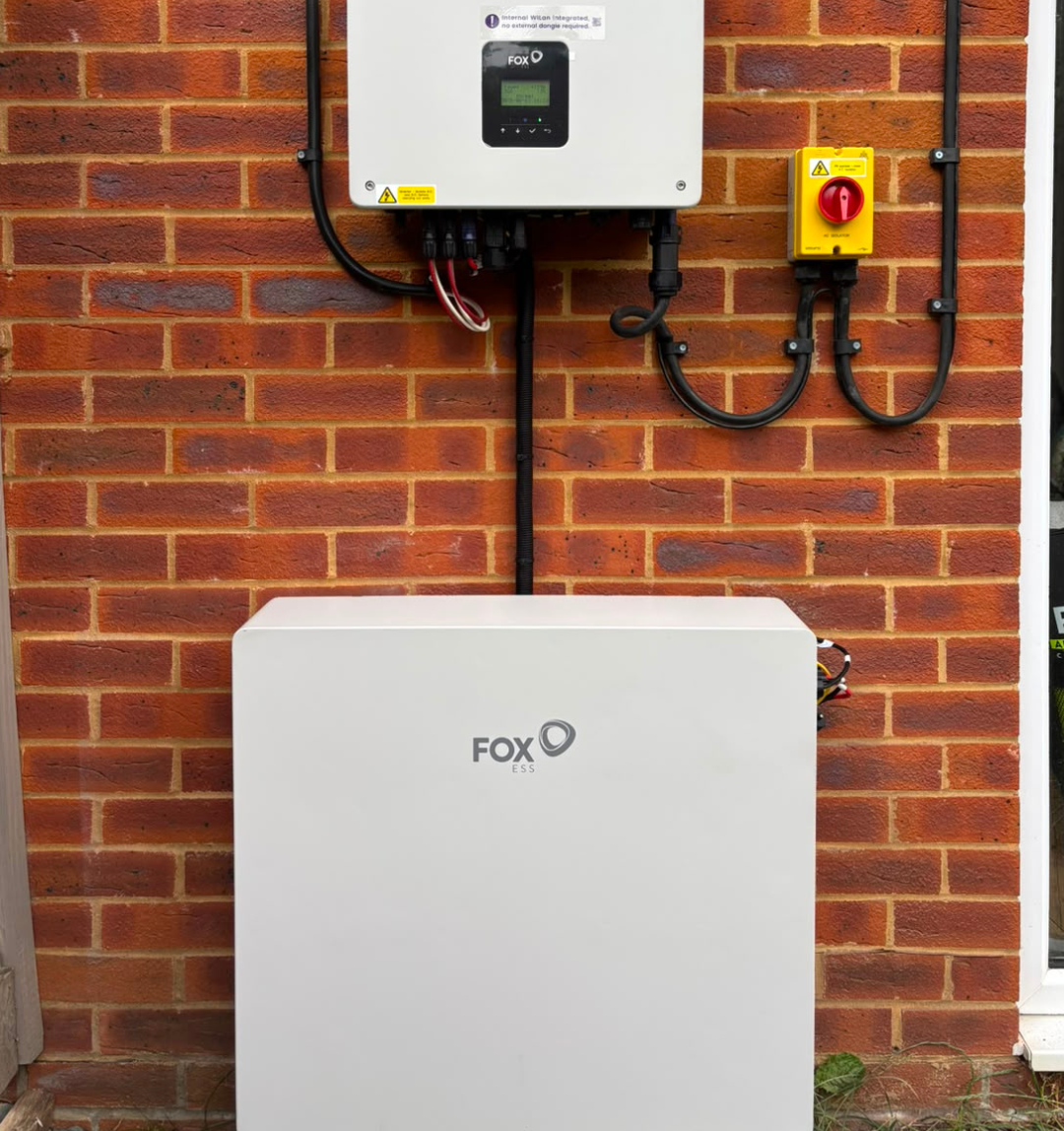
Yes, solar battery storage can be added to almost any existing solar PV system. The two retrofit routes are an AC-coupled battery, which works alongside the existing solar inverter, or a hybrid inverter replacement, which manages both together. A standalone retrofit battery qualifies for 0% VAT until 31 March 2027, and adding one does not automatically affect Feed-in Tariff or Smart Export Guarantee payments, provided the change is notified and the scheme’s metering requirements continue to be met.
If your solar panels have been sending unused electricity back to the grid for a fraction of what you would pay to buy it back in the evening, adding solar battery storage now is a different decision to the one you faced when the panels went up. The answer depends on what inverter you already have, how your household actually uses electricity, and what has changed in the rules since your system was installed, not just how many kilowatt-hours you generate.
This guide covers what a retrofit involves, whether it touches your Feed-in Tariff or SEG payments, how to size battery storage for solar you already have, and what two live 2026 dates mean for anyone doing this now. In simple terms, once the battery is fitted you store solar power in batteries instead of exporting it, then draw it back down after dark.
How retrofitting solar battery storage into an existing system actually works
An AC-coupled battery is the most common route into solar battery storage for a system that already exists. It has its own battery inverter and sits alongside the solar inverter you already have, converting the battery’s stored DC power to AC independently. Most existing solar systems can take this route without any change to the original inverter.
The alternative is a hybrid inverter replacement, where the existing solar inverter is swapped for one unit that manages both the solar array and the battery together. This is more integrated and can be slightly more efficient, but it is a more invasive job, because the original inverter comes out.
Which route applies to your system depends on the age and type of inverter already installed, not on which battery looks best online. A five or six-year-old string inverter usually takes an AC-coupled battery without complication. We confirm which route fits at survey stage before any conversation about battery size or brand, because pricing a job from the battery backwards, rather than from the inverter forwards, is how retrofit quotes end up needing a change order halfway through.
Will adding a battery affect your Feed-in Tariff or SEG payments
Adding solar battery storage to a system already generating under the Feed-in Tariff or SEG does not automatically affect those payments, but it is not something to assume without checking. Ofgem’s guidance on co-locating battery storage with FIT installations confirms that storage can be deployed alongside an accredited FIT installation without affecting its accreditation, provided the scheme’s requirements continue to be met. The same guidance is explicit that adding storage should be reported to the FIT licensee, with a diagram showing how the electricity from the installation reaches the storage facility and how it is metered.
For SEG installations, the position turns on the export meter. Payments continue where the meter can isolate what was generated by your solar panels from anything the battery has charged from the grid. Where a battery can be configured so it only charges from solar generation, this separation is straightforward. Where it can also charge from the grid on a cheap overnight rate, the metering arrangement needs to be capable of the same distinction, which is exactly the kind of detail a survey should confirm rather than assume.
This is not a formality. Skipping the notification step, or installing in a configuration the FIT or SEG licensee cannot verify, is how homeowners end up disputing payments months after the work is done. As an Octopus Trusted Partner, we handle the notification and the metering diagram as a standard part of a retrofit survey, not as paperwork you discover you needed after the battery is already on the wall.
Sizing a battery around how your household actually uses electricity
For most Surrey and Hampshire households retrofitting solar battery storage, the right size sits between 5 and 10 kWh. Sizing to the biggest unit that fits the utility room is a common trap. A 13.5 kWh battery sized to your worst-case daily consumption, rather than typical evening usage, sits underused for most of the year and takes far longer to earn back its cost.
The right size is set by how much electricity your household draws on a normal evening, not by the largest capacity available or by a single high-demand day. If you charge an electric vehicle at home overnight, that changes the calculation, because the battery and the EV are drawing from the same tariff window and the sizing question has to account for both. We size to typical evening use rather than worst-case daily consumption, which is the single most common place a retrofit quote goes wrong.
Getting this right depends on seeing actual usage, not guessing from a bill total, which is why a battery sizing conversation belongs at survey stage alongside the inverter compatibility check, not as an afterthought once a brand has already been chosen. You can add battery storage to your existing solar system once both questions have been answered together.
What 0% VAT and the new wiring rules mean for a retrofit right now
Two dates make 2026 a different moment to add solar battery storage than a year ago. HMRC’s guidance on VAT for retrofit battery storage confirms that a standalone battery added to an existing solar system qualifies for 0% VAT in residential accommodation, whether or not it is installed at the same time as the panels, and that this rate applies until 31 March 2027, reverting to the reduced rate after that date.
0% VAT on a retrofit battery runs until 31 March 2027. BS 7671 Amendment 4’s new battery storage chapter takes full effect from 15 October 2026, when the previous wiring regulations are withdrawn.
The second date is less well known but just as practical. The IET and BSI’s announcement of the new battery storage wiring chapter confirms this year’s Amendment to the IET Wiring Regulations introduces, for the first time, a dedicated chapter covering stationary secondary batteries. The previous edition of the regulations is withdrawn six months after publication, on 15 October 2026, after which new battery installations need to comply with the new chapter.
For a retrofit specifically, this matters because the new chapter includes location restrictions that did not exist under the old rules. A spot that would have been an acceptable place for a battery a year ago, a loft on an older FIT-era system is the common example, needs checking against the current requirements before you commit to it. This is exactly the kind of detail that sits at the intersection of the electrical work and the solar work, which is why our MCS certification for the solar side and NICEIC approval for the electrical side both matter for a retrofit, not just for a first installation.
The batteries Viable Power installs, and why we install more than one brand
Brand choice for solar battery storage is not a preference exercise. It comes down to what suits your inverter and what’s already in place, which is why we work with more than one manufacturer rather than defaulting to a single product for every home.
Alpha ESS uses a modular SMILE series with LiFePO4 chemistry, a good fit if you think you’ll want to add more storage capacity later without starting again. Fox ESS is also in the mix, offering hybrid inverters and battery storage as a straightforward, widely-installed option if you’d rather go with a proven system than the newest thing on the market. Growatt‘s hybrid inverters manage solar and battery together through a modular ARK battery range, which suits you if you’d rather have one integrated system than a battery bolted on to an inverter it wasn’t designed to work with.
Sigenergy‘s SigenStor combines the inverter, battery and EV charger in one unit, worth a look if you’re planning to add EV charging alongside the battery rather than treating the two as separate projects. SolarEdge‘s DC-coupled Energy Bank is the natural choice if you’re already running a SolarEdge inverter, or if your roof has shading that makes panel-level monitoring worth having.
We size and specify against what is already installed and what you plan to add next, not against a fixed product list. A battery that is the right answer for a neighbour’s SolarEdge system is not automatically the right answer for a five-year-old string inverter three doors down. As solar battery storage installers working across Surrey and Hampshire, this is the judgement call we make at survey stage on every retrofit.
Getting more from a retrofitted battery with your Octopus tariff
Solar battery storage added to an existing system earns its value largely through how the tariff is configured, not just on the hardware. As an Octopus Trusted Partner, we design retrofits to work with Octopus tariffs from day one rather than treating tariff setup as something to sort out after the system is switched on.
On Octopus Flux, a battery captures the daily spread between import and export rates, which works just as well on a retrofit as it does on a day-one installation, provided the system is configured for it. On Intelligent Octopus, the battery can be set to top up on the cheap overnight rate before solar generation takes over the following morning, which is particularly useful for a retrofit sitting on an older FIT arrangement where the export side of the equation was never designed with a battery in mind.
Already have solar and weighing up a battery?
If you already have solar and you are considering solar battery storage, get in touch. The instant quote tool gives you an indicative figure, and the contact form sends your enquiry straight to the team, who will arrange a proper survey to confirm what your existing inverter can take.
Get a quote for adding battery storageFrequently Asked Questions
Can I add a battery to solar panels installed years ago?
Yes, in almost all cases. Solar battery storage can be added to an older FIT-era system with a standard string inverter through an AC-coupled battery without complication, because the battery has its own inverter and does not require the original solar inverter to be replaced. The age of the panels themselves rarely matters. What matters is the type and condition of the existing inverter, which a survey confirms before anything else.
Will adding a battery affect my Feed-in Tariff payments?
Not automatically, but it must be handled correctly. Ofgem’s guidance confirms that co-locating storage with an accredited FIT installation does not affect accreditation provided the scheme’s requirements continue to be met, but the change needs to be reported to your FIT licensee with a diagram of the metering configuration. Skipping that step is the most common reason homeowners run into disputes over payments after the work is done.
What size battery do I need for my existing solar system?
Most Surrey and Hampshire solar battery storage retrofits land between 5 and 10 kWh. The right size is set by your typical evening electricity use, not the largest battery that fits the space or a single high-demand day. If you charge an electric vehicle at home overnight, that changes the sizing calculation, because both draws sit on the same tariff window.
Does 0% VAT still apply if I add a battery separately from my original solar installation?
Yes. HMRC’s guidance confirms that a standalone battery retrofitted to an existing solar PV system in residential accommodation qualifies for 0% VAT, whether or not it is installed at the same time as the panels. This applies until 31 March 2027, after which the rate reverts to the reduced rate.
Do I need to worry about where the battery is installed under the new wiring rules?
Yes, this is worth checking now. BS 7671 Amendment 4, published 15 April 2026, introduces the first dedicated chapter for battery storage in the IET Wiring Regulations, including location restrictions that come into full effect once the previous edition is withdrawn on 15 October 2026. A location that would have been fine under the old rules, particularly in an older property, is worth confirming against the current requirements before you commit to it.
Can I add a battery from a different brand to the one my original installer used?
Usually yes, through an AC-coupled setup, since the battery has its own inverter and does not need to match the solar inverter’s brand. A hybrid or fully integrated system, where solar and battery share one inverter, may need brand-matched components. Which route applies is confirmed at survey rather than assumed from the brand name alone.
