


Solar panels generate electricity when the sun shines. A battery stores whatever your home does not use immediately, so you can draw on it in the evening, overnight, or on dull days instead of buying from the grid. Together, the two systems raise your self-consumption rate from a typical 25 to 40% (solar only) to 60 to 80% or above, meaning a significantly larger share of what you generate actually reduces your electricity bill rather than being exported at a lower rate.
If you already have solar panels, or you are weighing up whether to include a battery from the start, this guide explains the mechanics, the savings case, and the practical decisions involved. It covers how the systems interact, how to size a battery correctly, how smart tariffs change the picture, and what to consider before you commit to a combined system.
The short version: solar alone is a strong investment. Solar with a correctly sized battery, used well, typically saves more. But the degree of extra benefit depends heavily on how and when your household uses electricity, and what tariff you are on. The survey and system design stage exists precisely to work through those variables for your specific property.
Why solar panels alone leave money on the table
A grid-tied solar system without a battery has one job: generate electricity when the sun is out and feed it into your home. Any surplus that your home is not using at that moment goes to the grid. Under the Smart Export Guarantee (SEG), your energy supplier pays you for that exported electricity, but the rate is typically far lower than what you pay to import. As of early 2026, export rates from most suppliers sit between 7p and 15p per kWh, while a standard import unit rate is around 24p to 28p. Every kilowatt-hour you export rather than use yourself effectively saves you less than half what it would save if consumed directly.
The mismatch between when solar generates and when households actually use electricity makes this worse. Solar output peaks around midday. Most household electricity demand peaks in the morning and evening, when people are at home, cooking, showering, and running appliances. A household where everyone is out during the day will export a large proportion of what the system generates, and buy back from the grid at standard rates in the evening. That is a workable arrangement, and solar-only systems still provide strong returns. But the gap between generation and consumption is real, and a battery closes it.
Self-consumption rate is the percentage of what your panels generate that your household actually uses, rather than exporting. A higher rate means more of your generation directly reduces your electricity bill. Batteries raise this figure by storing surplus generation for use later.
What a battery does and how the two systems interact
A home battery is, in practical terms, an overflow storage unit. When your solar panels are generating more electricity than your home is using at that moment, the surplus charges the battery rather than going to the grid. When your panels stop generating (after dark, in low light, or when demand suddenly spikes), the battery discharges and supplies the shortfall. You draw from the grid only when the battery is depleted.
The sequence looks like this in a typical day. During morning hours, your panels start generating as daylight increases. If demand is high (kettles, showers, appliances), solar may cover most of it directly. By midday, generation often exceeds what the home needs, and the battery starts filling. In the afternoon, the battery may be at or near full capacity. In the evening, generation falls as the sun drops, but the battery covers household demand. Overnight, you draw from the grid as normal until the next morning’s generation cycle restarts.
The inverter is the component that orchestrates all of this. In a hybrid inverter setup (the most common approach for new combined solar and battery installations), a single unit handles conversion from the panels, management of the battery charge and discharge, and the connection to the grid. This simplifies the wiring, reduces the number of components, and typically means the system can be monitored through a single app. If you are adding a battery to an existing solar system, we will check whether your current inverter is hybrid-compatible. If it is, adding a battery is usually straightforward. If not, a new inverter may be required alongside the battery.
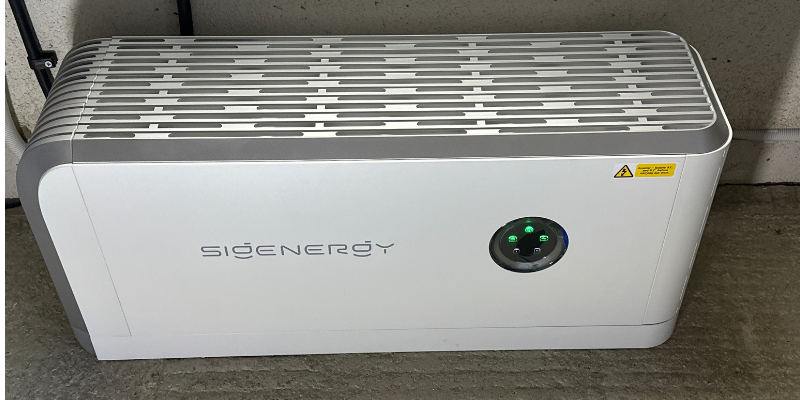
For a closer look at the brands we commonly install for battery storage, including Fox ESS, GivEnergy, and Sigenergy, our battery storage page sets out the options and what each is typically suited for.
The self-consumption numbers: what changes with a battery
The most commonly cited figures for self-consumption in UK homes run as follows. Without a battery, a typical household with a grid-tied solar system achieves a self-consumption rate of around 25 to 40%. That range shifts to 60 to 80% or above with a correctly sized battery added to the same system. The actual figure depends on several variables: the size of the solar array, the battery capacity, the household’s daily electricity demand, and when that demand falls during the day.
In practical terms, a household that moves from 35% to 70% self-consumption on a 4 kWp system generating roughly 3,400 to 3,600 kWh per year goes from using around 1,200 kWh of its own generation to using around 2,400 kWh, displacing roughly 1,200 additional units from the grid. At an import rate of around 26p per kWh, that is approximately £310 per year in additional savings beyond what the solar-only system was providing. The exact figure shifts with tariff rates and usage patterns, which is why any savings estimate from an installer should come with the assumptions attached.
It is also worth understanding the ceiling on self-consumption gains. Adding a larger battery than your system and usage warrant produces diminishing returns: if the battery regularly starts each day still partly charged from the previous evening, the extra capacity is doing nothing useful. The survey stage should include an honest assessment of how much storage makes sense relative to your system size and consumption profile.
How smart tariffs change the savings calculation
The economics of battery storage shifted significantly when time-of-use tariffs became widely available. Tariffs such as Octopus Go, Intelligent Octopus Flux, and British Gas Electric Driver offer off-peak periods, typically in the early hours of the morning, where the unit rate drops significantly, often to between 6p and 10p per kWh. During peak hours, the same tariffs charge standard or higher rates.
A battery combined with a time-of-use tariff creates a second saving mechanism alongside solar self-consumption. Rather than leaving the battery to fill only from solar generation during the day, you can also schedule it to charge from the grid overnight at the cheap rate and discharge during the day or evening when grid rates are higher. The battery stops being purely a solar storage device and becomes a broader energy management tool.
This changes how you should think about battery sizing. A household on a flat-rate tariff benefits mainly from storing solar surplus. A household on a time-of-use tariff benefits from both storing solar surplus and from grid arbitrage (buying cheap, using when expensive), which typically justifies a larger battery. We factor the tariff landscape into our system recommendations from the start. The guide to Octopus Energy tariffs and solar covers how specific tariffs interact with solar and battery systems in more detail.
Savings from a solar and battery system depend on your current tariff, your usage pattern, your system size, your roof’s orientation and shading, and how electricity prices move over the life of the system. Any figure cited as a “typical saving” reflects specific assumptions. When we put a quote together for you, we show the assumptions clearly so you can judge whether they apply to your household.
Sizing a battery: how to get this right
Battery capacity is measured in kilowatt-hours (kWh). The question is how much storage you actually need relative to what your solar system generates and when your home uses electricity.
The starting point is your household’s daily electricity demand, particularly in the hours after the solar system stops generating. For a gas-heated home (boiler for heating and hot water), electricity use is driven mainly by lighting, appliances, and cooking. The Energy Saving Trust’s guidance on solar battery storage notes that a 5 kWh battery is a common choice for this profile, as it typically provides enough storage to cover evening and overnight use from a single day’s surplus generation. For a home with electric heating or a heat pump, electricity demand is substantially higher, and a 9 kWh or larger battery is more common.
If you have an electric vehicle or are planning to add one, that changes the sizing question considerably. A typical EV charge from near-empty adds 6 to 10 kWh of demand. A battery sized only for household use may not stretch to cover meaningful EV charging as well. Sizing up at installation is generally cheaper than retrofitting additional capacity later, so if an EV is on the horizon, it is worth factoring into the initial design.
There is also a technical factor: usable capacity is not the same as stated capacity. Most lithium-ion batteries are designed not to be fully discharged on every cycle, and real-world usable capacity is typically 90 to 95% of the headline figure. A battery quoted at 10 kWh may deliver around 9 to 9.5 kWh of usable storage in practice. We always work from usable capacity when sizing a system.
| Household profile | Typical daily demand | Common battery size | Notes |
|---|---|---|---|
| Gas-heated home, 2 to 3 bedrooms | 7 to 10 kWh | 5 to 7 kWh | Evening and overnight cover from a single day’s solar surplus |
| Gas-heated home, 4+ bedrooms | 10 to 15 kWh | 7 to 10 kWh | Higher demand may also justify a larger solar array |
| Home with heat pump | 15 to 25 kWh | 9 to 15 kWh | Electric heating increases both solar and storage requirements significantly |
| Home with EV (current or planned) | +6 to 10 kWh per charge | Size up accordingly | Factor EV demand into sizing from the start if possible |
These are illustrative ranges. We base our recommendations on your actual electricity bills, your current or planned tariff, and the output profile of your proposed solar array, not on generic household type alone.
EV charging and the three-way system
If you have an electric vehicle, a solar and battery system creates a third layer of potential savings: charging your car from stored solar electricity rather than from the grid.
The practical picture depends on which charger you have installed. A standard 7 kW home charger will draw down a battery reasonably quickly. A charger with solar integration, such as the Zappi v2, adjusts its charge rate to prioritise surplus solar generation, effectively directing excess output straight into the car rather than into the battery. This makes sense on sunny days when your battery is already full and you have surplus generation to use.
The combination of solar, battery, and an integrated EV charger gives you the most flexibility: surplus solar charges the battery or the car as conditions and demand dictate, and the battery can cover household evening demand while the car charges overnight on a cheap off-peak tariff if the battery has been topped up from solar during the day. The Zappi v2 page covers how that charger handles solar integration specifically.
Battery backup: what it does and does not provide
One question that frequently comes up around battery storage is whether it provides backup power during a grid outage. The answer depends on how the system is configured, and it is worth understanding the distinction before assuming that adding a battery means you will have power when the grid goes down.
The standard configuration for a grid-tied solar and battery system is Emergency Power Supply (EPS) mode. In an EPS setup, the system can keep specific circuits running during a grid outage, typically a few ring circuits designated to cover essentials. It is not the same as powering everything in your home as normal. The output capacity of an EPS system is also limited compared to your full grid supply, so high-draw appliances such as electric showers, ovens, or heat pumps may not run from EPS.
A full whole-home backup configuration is a different and more complex installation. It requires equipment capable of supplying the full load of the property from the battery and solar system alone, and is sized and installed differently from a standard EPS setup. If grid resilience is a primary reason you are interested in battery storage, the right question to raise with us is whether you need EPS or whole-home backup, because the cost and equipment differ significantly. The EPS vs whole-home backup guide explains both configurations in plain terms.
Installing solar and battery together versus adding a battery later
There are practical and financial reasons to think carefully about whether to install solar and battery together from the start, or to add a battery as a retrofit.
Installing both at the same time is generally cheaper per component. We are on-site once, the electrical work is done together, and a hybrid inverter is specified from the outset. If you specify a hybrid inverter but defer the battery itself, you can add it later without replacing the inverter, which keeps the retrofit cost lower. If you install a non-hybrid inverter and then want to add a battery, you may need a new inverter alongside the battery, which adds cost.
The case for deferring a battery typically comes down to budget. Solar on its own has a shorter payback period than solar with a battery, because the additional cost of the battery has to generate enough extra savings to justify itself. If budget is the constraint, solar first and battery later is a reasonable approach, provided the system is specified with future battery compatibility in mind.
The case for installing both together is strongest when you are on or planning to move to a time-of-use tariff, when you have an EV, or when evening electricity use is high. In those circumstances, the battery starts earning its keep from day one and the overall system delivers more value sooner.
The Smart Export Guarantee and where battery storage fits
Adding a battery does not affect your eligibility for the Smart Export Guarantee, and it does not prevent export payments. What it does is change how much you export, because more of your generation is stored and used rather than going to the grid. If your battery is full and your solar system is still generating, surplus electricity is exported as normal and earns the SEG rate from your supplier.
Whether you prioritise self-consumption or export depends on your tariff. For most households on a flat-rate tariff, using electricity yourself at 26p+ per kWh is more valuable than exporting it at 7 to 15p. On a well-structured time-of-use tariff, the arithmetic changes, because cheap overnight grid electricity can sometimes be imported at less than the SEG export rate, creating opportunities for more strategic battery management.
MCS certification remains a condition of SEG eligibility. Any solar installation that forms part of a combined solar and battery system should be MCS-certified — you can verify an installer’s current MCS status via the MCS certified installer search. We are MCS-certified, and we provide the MCS certificate at handover as part of the documentation you need to register for a SEG tariff. We are also registered with TrustMark (a government-endorsed quality scheme) and are a member of RECC (the Renewable Energy Consumer Code), which provides consumer protections and a dispute resolution process. For current SEG eligibility guidance and to understand which suppliers offer export contracts, the GOV.UK Smart Export Guarantee guidance is the definitive reference.
All solar and battery systems connecting to the grid also require notification to your distribution network operator (DNO). Smaller systems follow the G98 notification process; larger or more complex systems require prior G99 approval. We handle whichever process applies as part of every installation — it is included in the quoted price. The G98 Single Premises Summary Guide and G99 Type A Summary Guide from Energy Networks Association set out the technical requirements for reference.
VAT and cost: what applies to a combined system
As of March 2026, domestic solar panel and battery storage installations in Great Britain are subject to 0% VAT when the battery is installed at the same time as the solar panels, or when it qualifies under the energy-saving materials rules. This VAT relief applies until at least 31 March 2027 under current legislation. The position on retrofit battery storage (battery added to an existing solar system) can differ. Always confirm the current VAT position with us before committing, and check HMRC Notice 708 for the definitive rules. VAT treatment is subject to change.
For a typical combined domestic solar and battery installation in Surrey and Hampshire, combined system costs generally run from around £10,000 to £16,000 depending on system size, battery capacity, and any additional work required (consumer unit upgrades, scaffolding, cable runs). These are guide ranges and your actual quote will depend on a survey of your specific property. Use the online quote builder for an indicative figure based on your roof, usage, and hardware preferences.
If upfront cost is a consideration, finance may be available via an FCA-authorised credit broker. We are an Introducer Appointed Representative of Phoenix Financial Consultants Limited. Finance is subject to status; details and eligibility criteria are provided by the broker.
Solar panels vs solar and battery: a side-by-side view
Solar only
Lower upfront cost. Faster payback period, typically 6 to 9 years. Self-consumption rate of 25 to 40%. Earns SEG payments on all surplus. No backup in grid outage. Best for budget-conscious buyers who want strong returns per pound spent.
Solar and battery
Higher upfront cost. Payback typically 8 to 12 years (varies significantly with tariff and usage). Self-consumption rate of 60 to 80%+. Greater bill reduction and more grid independence. EPS backup available. Best suited to households with high evening demand, EVs, or time-of-use tariffs.
Battery retrofit later
Spreads the cost. Works if initial system uses a hybrid-compatible inverter. Battery can be added as a half-day job in most cases. Allows you to judge actual solar savings before committing to storage. Costs slightly more overall than installing both together from the start.
Ready to see what works for your home?
The online quote builder takes around five minutes and gives you an indicative system design, cost, and savings estimate based on your roof and energy use. A survey then confirms the right battery size, inverter type, and everything included in the final price.
Get your free solar quoteFrequently Asked Questions
Can I add a battery to my existing solar system?
Yes, in most cases. If your existing inverter is a hybrid model, a battery can be added without replacing it, typically as a half-day installation. If your inverter is a standard string inverter, you may need to replace it with a hybrid unit at the same time as adding the battery, which adds to the overall cost. We can confirm inverter compatibility from the make and model of your current equipment before any work is planned.
How much extra can I save by adding a battery to solar panels?
The additional annual saving from a battery depends on your current self-consumption rate, your tariff, and how much you export. For a typical household moving from roughly 35% to 70% self-consumption on a 4 kWp system, the extra saving is likely to be in the range of £200 to £400 per year at current electricity prices, with higher figures possible on time-of-use tariffs. When we put together your quote, we show you the calculation with your specific usage and tariff assumptions applied, rather than relying on generic figures.
Does a battery mean I have power during a blackout?
It depends on the system configuration. A standard grid-tied battery provides Emergency Power Supply (EPS), which keeps specific circuits running during a grid outage. It does not power your whole home as normal. A whole-home backup setup is a separate and more complex configuration that costs more and is sized differently. If backup power is important to you, clarify at the survey stage which configuration you need. The EPS vs whole-home backup guide explains both options in detail.
What battery size do I need for a typical 3 or 4 bedroom home?
For a gas-heated 3 to 4 bedroom home, a 5 to 10 kWh battery typically covers evening and overnight demand from a single day’s solar surplus. Larger households, homes with heat pumps, or households with electric vehicles usually need more capacity. The right answer comes from looking at your actual electricity bills, your usage pattern (particularly what you use in the evening), and the output profile of your proposed solar array. A survey will produce a properly sized recommendation rather than a rule-of-thumb figure.
Can I charge a battery from the grid as well as from solar?
Yes. Most modern home batteries can charge from the grid as well as from solar. On a time-of-use tariff with cheap overnight rates, you can schedule the battery to charge from the grid during low-cost periods and discharge during higher-rate periods. This grid arbitrage strategy works alongside solar self-consumption and can significantly improve overall system economics, particularly in winter when solar generation is lower.
How long does a solar battery last?
Most lithium-ion home batteries carry warranties of 10 years and are designed for a lifespan of 10 to 15 years under normal operating conditions. Actual longevity depends on usage cycles, depth of discharge, and operating temperature. When comparing systems, check both the warranty period and the warranted capacity retention at the end of that period, as some warranties cover a minimum usable capacity (for example, 70% of original capacity at year 10) rather than simply guaranteeing the battery works at all.
Does adding a battery affect my Smart Export Guarantee payments?
Adding a battery does not disqualify you from the SEG, and surplus electricity is still exported and paid for in the normal way. What changes is how much you export: because more of your generation is stored and used, less goes to the grid. Whether this reduces your overall financial return depends on the gap between your import rate and your export rate. For most households, using electricity yourself at the import rate is worth more than exporting it at the SEG rate, so higher self-consumption generally means better financial outcomes overall.
Next steps
If you are considering a combined solar and battery system in Surrey, Hampshire, or the surrounding area, here is how to move forward.
- Use the online quote builder to get an indicative system design and price. It covers roof details, usage, hardware options, and estimated savings, and takes around five minutes to complete.
- Read the battery storage page for a full overview of the brands we commonly install, including Fox ESS, GivEnergy, and Sigenergy, and what to consider when choosing between them.
- If you want to understand the full financial picture before committing, the solar panel ROI guide covers payback periods, net return calculations, and the variables that affect what your system actually saves.
- For the core solar installation offer, the solar panel installation page sets out what an MCS-certified installation with us includes from survey through to handover.
- If you have an electric vehicle or plan to get one, the EV charging points page covers home charger options and how a charger can be integrated with your solar and battery system for maximum savings.
