


The most reliable way to choose a local solar or EV charger installer is to verify their accreditation stack first, then assess their process. An MCS-certified installer is the minimum requirement for solar if you want to claim Smart Export Guarantee payments. For EV charging, look for NICEIC or equivalent electrical certification and evidence that the installer handles DNO notification as part of the job. Referencing consumer-code membership (RECC or TrustMark) gives you a structured complaints pathway if something goes wrong after installation.
This guide is for homeowners and business owners in Surrey, Hampshire, and the wider South East who are shortlisting solar, battery storage, or EV charger installers and want to know what actually separates a good one from a poor one. It focuses on what the accreditations mean in practice, how to read a quote, what to ask before you commit, and the specific questions that reveal whether an installer is genuinely capable or just good at answering the phone.
One point worth setting expectations on upfront: the cheapest quote rarely reflects the total cost of a well-specified installation. DNO paperwork, scaffolding access, consumer unit suitability, and post-install monitoring all affect whether your system performs as expected. An installer who does not mention these things in the first conversation is not saving you money; they are deferring the conversation about what is not included.
Why accreditation is the first filter, not a box-ticking exercise
A solar installation that is not MCS-certified cannot access Smart Export Guarantee (SEG) payments. That is not a preference; it is a market rule. The GOV.UK Smart Export Guarantee guidance is clear: to apply for an export tariff from an eligible energy supplier, your system must have been installed by an MCS-certified installer. The MCS certification also means the installer has been independently assessed against MIS 3002, the standard that governs solar PV system design, installation quality, and commissioning. You can verify any installer’s MCS status using the MCS find-an-installer tool.
NICEIC certification covers the electrical side of the work. Solar installations, EV charger installations, and battery storage all involve work on your home’s consumer unit and distribution board. NICEIC assesses electrical contractors against the current wiring regulations (BS 7671) and requires regular inspection of their workmanship. This matters for both safety sign-off and insurance: your home insurer may not cover work done by an unregistered electrician. For solar specifically, the combination of MCS and NICEIC means one contractor is accountable for both the microgeneration system and the electrical integration.
Two consumer-code memberships add a layer of protection that is separate from technical quality. TrustMark is a government-endorsed quality scheme with a public directory: if an installer is listed, you can verify their status before signing anything. RECC (Renewable Energy Consumer Code) provides a code of conduct, cooling-off rights, and a formal dispute resolution route if a problem is not resolved directly. Our accreditations page and the public TrustMark and RECC directories both carry our listing, which means you can independently check our status rather than taking our word for it.
For EV charger installations specifically, the installer must also comply with the Electric Vehicles (Smart Charge Points) Regulations 2021, which require all new home chargers to include smart functionality: scheduled charging, load balancing capability, and remote monitoring. An installer who offers chargers without these features is not compliant with current UK regulations.
What a well-specified quote actually covers
A quote that lists only “4kW solar system, panels and inverter, installation” is not a complete quote. The variables that affect both cost and whether the installation goes smoothly are the items most commonly left out of low-headline-price proposals. Before you compare quotes on price, check that each one addresses the same scope.
For solar PV installations, a complete quote should include: MCS-certified installation, DNO application or notification (G98 for smaller systems, G99 for larger or more complex setups), all cabling and electrical accessories, scaffolding or access (or a clear statement that it is excluded and priced separately), and commissioning with handover documentation including the MCS certificate you need to register for SEG payments. The G98 Single Premises Summary Guide and the G99 Type A Summary Guide from Energy Networks Association set out what these processes involve. We handle whichever applies as part of every solar installation, included in the quoted price rather than billed as an extra after survey.
For EV charger installations, the equivalent scope includes: the charger unit itself, a pre-installation survey (either in-person or detailed photo-based), all cabling to the consumer unit, any consumer unit assessment and confirmation that your supply can handle the additional load, and commissioning including pairing to your app or tariff if relevant. A 7kW single-phase charger is standard for most domestic properties; upgrading to a three-phase supply is rarely needed for a home but should be identified at survey, not mid-installation. Charger compatibility with your specific EV and your home’s tariff (particularly if you have solar and want to maximise self-consumption) is worth confirming before selecting the unit.
If two quotes differ significantly in price, list out what each includes line by line before drawing any conclusions. A cheaper quote that excludes DNO paperwork, scaffolding, or consumer unit work is often more expensive once those items are added back in.
The solar-plus-EV integration question most buyers do not ask
If you have solar panels, or are planning to install them alongside an EV charger, the charger you choose and how it is configured materially affects how much of your own generated electricity you actually use. This is not a marketing angle; it is an engineering question that most generic “how to choose an installer” guides skip over entirely.
Solar-compatible EV chargers like the Zappi v2 can detect surplus generation and automatically direct it to your car rather than exporting it at the (typically lower) export rate. The practical difference depends on your household’s daytime electricity use and how often your car is parked at home during daylight hours, but for homes with a 4kW or larger solar array and a car that charges regularly at home, the optimisation can be meaningful over a full year. An installer who installs EV chargers without understanding solar integration cannot give you a useful answer on this question, which is a sign that they are operating outside their competence.
The same integration logic applies to battery storage. If you want your battery to prioritise solar charging over grid charging, and then release stored energy for your EV in the evening, that requires a compatible inverter, battery, and charger setup, plus correct configuration at commissioning. Getting this right requires an installer who understands the full system, not just individual components. Our solar panel installation page and the EV charging points page set out how we approach the joined-up design question.
Local versus national: what the trade-off actually looks like
The local-versus-national debate in solar and EV installation often produces oversimplified conclusions in both directions. The genuine trade-offs are more specific than “local is personal” versus “national has more experience.”
A local installer rooted in Surrey or Hampshire is more likely to understand the specific planning picture in your area: AONB coverage in the Surrey Hills and South Downs, Article 4 directions in certain conservation areas, and the local DNO’s preferences for G98 notifications. They are also more likely to be operating with their own direct workforce rather than subcontracting to a third party, which matters for accountability when questions arise after the installation is complete. The question to ask any installer is: who actually does the installation, and who do you call if something needs attention six months later?
National brands have the advantage of volume-buying on equipment and a larger portfolio of completed projects. The risk is that the sales team and the installation team are different people, and aftercare routes through a central call centre rather than the installer who did the work. Neither model is universally better; what matters is whether the installer can tell you clearly who will be on site, what their credentials are, and how aftercare works in practice.
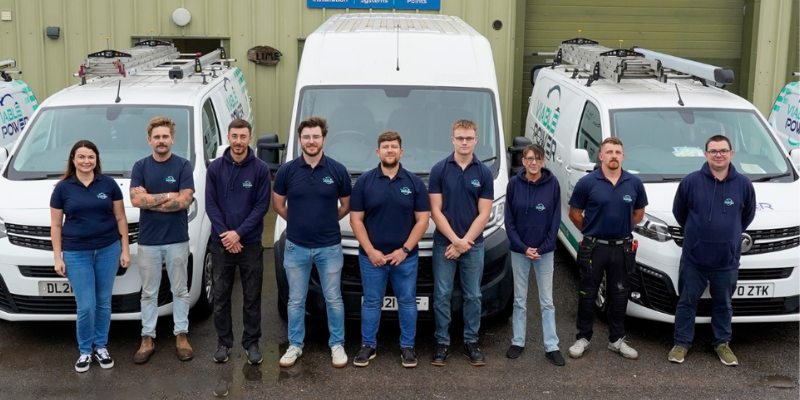
For buyers in Surrey, Hampshire, and nearby towns, we operate from our base in Tilford, Farnham, with a named team and direct accountability for installs in the local area. That is a structural difference from a national brand using a subcontracting network, and it is the kind of difference that becomes relevant when you want to speak to someone who actually knows your system.
Accreditation translation: what each certification actually protects you from
Most buyers have heard that “MCS is important” but fewer know what specific risks each certification addresses. The table below translates the four key accreditations into the buyer problem each one solves.
| Accreditation | What it covers | What happens without it |
|---|---|---|
| MCS | Quality assurance for the solar system design, installation, and commissioning. Issued by an independent certification body. | You cannot register for Smart Export Guarantee payments. Some home insurance policies may not cover damage related to a non-MCS installation. |
| NICEIC | Assessment of electrical contracting competence against BS 7671. Regular inspection of completed work. | Electrical work cannot be self-certified under Part P of Building Regulations. Work may need separate third-party sign-off, adding cost and delay. |
| TrustMark | Government-endorsed quality scheme with a public directory. Requires compliance with a code of conduct and customer satisfaction monitoring. | No third-party consumer quality standard. Complaints are handled directly between you and the installer with no structured escalation route. |
| RECC | Consumer code specific to renewable energy. Covers cooling-off rights, contract clarity, and dispute resolution via an independent ombudsman. | No structured consumer protection for the contract itself. Disputes rely on general consumer law rather than a sector-specific code. |
Red flags that are worth walking away from
The solar and EV installation market includes a significant number of sales-led operations whose competence in design and installation does not match their proficiency in generating enquiries. These are the warning signs that experienced buyers and trade bodies consistently identify.
A quote without a site survey. Any installer quoting a solar system without visiting the property, or at minimum conducting a detailed roof and electrical assessment using photos and satellite data, cannot give you an accurate price. A remote indicative quote is reasonable as a starting point; a final quote without an in-person survey is not. The survey is how the cable route, consumer unit suitability, roof structure, and shading are confirmed. Without it, the risk of surprises on installation day is high.
Pressure to sign quickly with a time-limited offer. Legitimate installers do not apply artificial deadlines. If a price depends on signing within 48 hours, that is a sales technique rather than a genuine constraint. RECC membership requires installers to give you a 14-day cooling-off period from the date of signing the contract, which means a compliant installer will not pressure you out of exercising that right.
Vague or absent inclusions list. If a quote does not state explicitly what is included and what is not, the likelihood of additional costs emerging later is high. Specifically: is DNO paperwork included? Is scaffolding included, or priced separately? What happens if the consumer unit needs upgrading? A reputable installer addresses these questions before you sign, not after.
No verifiable public accreditation listing. MCS, TrustMark, and RECC all maintain public directories. If an installer claims MCS certification but does not appear in the MCS installer search, or claims TrustMark registration but does not appear in the TrustMark directory, that is a serious concern. Always verify independently before signing.
An installer who cannot explain the DNO process. Grid-connected solar systems require notification to your distribution network operator. If the installer does not know what G98 or G99 refers to, or says “we handle it but I’m not sure of the details,” that is a sign that either they subcontract it without understanding it, or they have not done it before at the complexity level your system may require.
Questions to ask before you agree to anything
These questions are calibrated to reveal the difference between installers who understand the work and those who are primarily focused on closing the sale. A capable installer should welcome them and answer them specifically. Vague or evasive answers are informative in themselves.
Ask about the installation team: are the people doing the installation your direct employees, and do they hold the relevant NICEIC or MCS certifications, or is the work subcontracted? Ask how they handle the DNO process and what the expected timeline is between signing and grid connection. Ask what is included in the quoted price and for a written inclusions list before you sign. Ask how aftercare works: who do you contact if there is a performance issue six months post-installation, and what is the process?
For solar specifically, ask what happens if the survey reveals a consumer unit upgrade is needed, and how that is priced. Ask what monitoring is provided and whether you can track system output in real time. Ask whether the quote price includes all the items needed to register for SEG payments, including the MCS certificate and the commissioning documentation.
For EV charger installations, ask whether the charger is compatible with your specific vehicle and your current or planned tariff. If you have solar, ask whether the charger supports solar-optimised charging and what that requires in terms of configuration. Ask whether the installer will register the charger with the DNO where required, and what smart charging regulations apply to the unit they are recommending.
Finance, VAT, and the incentive picture in 2026
Two financial factors are worth understanding clearly before signing anything, because both affect the real cost of your installation.
As of March 2026, domestic solar panel installations in Great Britain attract 0% VAT on qualifying installations. This is not permanent: it is subject to policy and should be confirmed at the time of your installation. Always check the current position via HMRC Notice 708 before making a final decision. Our quoted prices reflect the applicable VAT rate at the time of installation.
The Smart Export Guarantee provides export payments for surplus electricity sent to the grid from MCS-certified systems. Rates are set by individual suppliers and vary; there is no government floor rate. The GOV.UK guidance linked above sets out which suppliers are required to offer export tariffs and how to apply once your system is commissioned.
Finance is available for solar installations through Viable Power, via an Introducer Appointed Representative arrangement with Phoenix Financial Consultants Limited, an FCA-authorised credit broker. This is not a Viable Power loan; it is a credit agreement arranged by an authorised broker. Eligibility is subject to status, and the terms are set by the broker. If you are considering financing a solar system, ask for a plain-English explanation of the arrangement before the survey, so you can compare the total cost of financed versus upfront purchase accurately.
Ready to get a quote from a local, accredited installer?
We serve homeowners across Surrey and Hampshire from our base in Tilford, Farnham. Use the online quote builder to get an indicative system design and cost in minutes, with no obligation to proceed.
Frequently Asked Questions
How do I check if a solar installer is genuinely MCS-certified?
Use the MCS find-an-installer tool at mcscertified.com and search by postcode or installer name. If the installer appears in the results with an active certification status, their MCS registration is current. Do not rely solely on a badge on an installer’s website; verify the listing independently before signing a contract. MCS certification can lapse if an installer fails an inspection, so checking at the point of decision is more reliable than checking when you first made contact.
Does the installer need to be local, or can I use a national solar company?
There is no requirement to use a local installer, but there are practical reasons why local accountability matters for a long-horizon investment like solar. A locally based installer with a named team is more accessible for post-install queries and is more likely to be operating with direct employees rather than subcontractors. National installers can offer competitive pricing and a larger completed-project portfolio. The key question to ask either type is: who specifically will carry out the installation, what are their credentials, and who do you contact if something needs attention after the system is commissioned?
What does RECC membership protect me from?
RECC membership requires the installer to comply with the Renewable Energy Consumer Code, which sets standards for sales practices, contract terms, and consumer information. Practically, it means you have a 14-day cooling-off period from the date of signing the contract, the installer cannot use misleading sales tactics, and you have access to an independent dispute resolution service if a complaint is not resolved directly. RECC does not cover workmanship warranties or system performance; those are handled separately through manufacturer warranties and MCS standards.
What is the difference between G98 and G99 for solar installations?
G98 and G99 are the two connection standards for small solar systems connecting to the UK grid. G98 covers smaller or simpler systems (typically under 3.68kW per phase) and requires the installer to notify the local distribution network operator (DNO) after installation. G99 applies to larger or more complex systems and requires prior approval from the DNO before installation proceeds, which can add weeks to the timeline. Your installer determines which applies based on your system design. We handle both processes as part of every solar installation, included in the quoted price. Ask any installer you are shortlisting which standard applies to their proposed system and whether that changes the installation timeline.
Can I install an EV charger and solar panels at the same time?
Yes, and for many households it is the most practical approach, particularly if a consumer unit upgrade or rewire is part of the plan. Installing both at the same time means the electrical infrastructure work is done once, the cable routes can be planned together, and a solar-compatible charger like the Zappi v2 can be configured to maximise self-consumption from day one. If you are planning solar in the near future and installing an EV charger now, it is worth telling your EV charger installer so they can position the unit and plan the consumer unit connections in a way that makes the solar integration straightforward when it happens.
What is a reasonable cooling-off period for a solar installation contract?
Under the Renewable Energy Consumer Code, RECC members are required to give buyers a 14-day cooling-off period from the date the contract is signed. During this period you can cancel without penalty. If an installer is not RECC-registered, the Consumer Contracts Regulations 2013 may still provide a 14-day right of withdrawal for contracts signed off-premises (for example, at a home visit). Be cautious of any installer who pressures you to sign quickly or implies the cooling-off period is shorter than 14 days; this is not compliant practice under either framework.
Do I need to tell my energy supplier when I install solar?
Your installer handles the DNO notification as part of the installation process, which satisfies the grid-connection requirement. Separately, once your system is commissioned and you have your MCS certificate, you apply directly to an eligible energy supplier of your choice to register for Smart Export Guarantee payments. You do not have to use your current energy supplier; you can compare export tariff rates across eligible suppliers and choose the best offer. Some suppliers (like Octopus Energy, with whom Viable Power has a stated partnership) offer specific tariffs that integrate well with solar systems and batteries, including options for optimised off-peak charging. The guide to Octopus tariffs and solar covers how this works in practice.
What happens if my installer goes out of business after installation?
This is a legitimate concern with a long-horizon investment like solar. The practical protections are: manufacturer warranties on panels, inverters, and batteries (which run directly with the manufacturer, not the installer); any workmanship warranty provided by the installer; and if the installer was an IWA member with deposit protection, a degree of protection on the deposit paid. MCS-certified systems can also be serviced by any other MCS-certified installer if your original installer is no longer trading. When shortlisting installers, ask about their IWA membership status, what deposit protection they offer, and whether their workmanship warranty is backed by a third-party insurer. We offer deposit and warranty protection; confirm the specific terms before signing.
Next steps
If you are shortlisting solar or EV charger installers in Surrey, Hampshire, or the surrounding area, here is how to move forward with confidence.
- Use the online quote builder to get an indicative system design and price based on your roof and usage. It covers hardware options, estimated savings, and what is included in the price, and takes around five minutes.
- Read the accreditations page for a full breakdown of Viable Power’s certification stack and what each accreditation means in practice for your installation.
- If you are considering solar panels, the solar panel installation overview covers what an MCS-certified installation includes, what happens at survey and commissioning, and how the process works from first contact to handover.
- For EV charging, the EV charging points page covers the charger options Viable Power installs, including the Zappi v2 for solar-integrated households and the Project EV range for homes and commercial settings.
- If you have questions before you are ready to get a quote, contact us directly. We are based in Tilford, Farnham, covering Surrey, Hampshire, and surrounding towns.
